
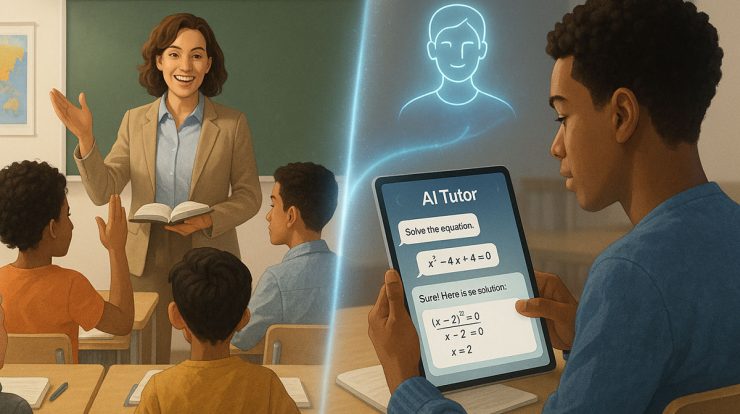
In an age where artificial intelligence can generate code in seconds, answer technical questions instantly, and even assemble entire web pages on command, it’s tempting to believe that human instruction is becoming obsolete. AI assistants are fast, scalable, and available 24/7. For many tasks, they are undeniably useful. But when it comes to truly learning how to build a website—not just assembling one—a live, one-on-one professor still offers advantages that AI cannot replicate.
This isn’t about dismissing AI. It’s about understanding the difference between tools that help you produce and teachers who help you grow. Building a website is not just a technical process—it’s a layered skill involving design thinking, problem-solving, debugging, architecture, and judgment. And that’s where a human mentor shines.
1. Learning Is Not Just Output—It’s Understanding
AI assistants excel at producing answers. You ask for a responsive navigation bar, and you get code. You ask for a bug fix, and you get suggestions. But receiving an answer is not the same as understanding it.
A live professor does something fundamentally different: they teach you how to think. Instead of just giving you a solution, they can:
- Ask you why your approach isn’t working
- Guide you through the reasoning behind a fix
- Challenge your assumptions
- Adjust explanations based on your current level
This back-and-forth builds mental models. You begin to understand why certain structures work, not just what to type. That distinction matters. When you encounter a new problem—one you can’t easily prompt into existence—you’ll rely on that understanding.
AI tends to shortcut the struggle. A professor helps you benefit from it.
2. Real-Time Adaptation to Your Learning Style
Every learner is different. Some people grasp concepts visually. Others need analogies, repetition, or hands-on practice. AI can approximate personalization, but it doesn’t truly perceive you.
A one-on-one professor can:
- Notice when you’re confused—even if you don’t say it
- Change explanations mid-sentence based on your reaction
- Slow down or speed up dynamically
- Reframe concepts in multiple ways until they click
If you’re stuck on CSS layout, a professor might draw diagrams, use metaphors, or walk through your specific project. If you’re overwhelmed by JavaScript, they can break it into digestible steps tailored to your pace.
AI, by contrast, responds to prompts. It doesn’t observe hesitation, frustration, or subtle misunderstandings unless you explicitly articulate them—and even then, it can misinterpret your intent.
3. Accountability and Consistency
One of the hardest parts of learning web development isn’t technical—it’s psychological. Staying consistent, pushing through frustration, and maintaining momentum require discipline.
A live professor introduces accountability:
- Scheduled sessions create structure
- Progress is monitored over time
- You’re encouraged (or challenged) when motivation dips
- Goals are set and revisited
With AI, the burden of discipline falls entirely on you. There’s no external expectation, no one noticing if you’ve stalled for two weeks, no guided roadmap unless you actively seek one out.
A professor doesn’t just teach content—they help you stay on track.
4. Context Matters—and Humans Understand Context Better
Building a website isn’t just about writing code. It involves decisions about:
- User experience
- Accessibility
- Performance trade-offs
- Design consistency
- Project goals
These decisions are often nuanced and context-dependent. A professor can evaluate your specific project and provide tailored advice.
For example:
- “This layout works technically, but it’s confusing for users.”
- “Your navigation hierarchy doesn’t match your content goals.”
- “This solution is clever, but it’s not maintainable.”
AI can provide general best practices, but it often lacks deeper contextual awareness. It doesn’t truly understand your long-term vision, your audience, or your constraints unless you meticulously describe them—and even then, its guidance may remain generic.
Human instructors bring experience, intuition, and judgment shaped by real-world work.
5. Debugging Is a Skill—Not Just a Fix
One of the most critical skills in web development is debugging. Things will break. Often.
AI can help identify errors quickly, but it often encourages a pattern of dependency:
- Paste error → get fix → move on
A professor, however, teaches how to debug:
- How to isolate the problem
- How to read error messages effectively
- How to test assumptions
- How to think systematically
They might even intentionally not give you the answer right away, guiding you instead through the process of discovery. That struggle builds resilience and independence.
Without that skill, you become reliant on external tools. With it, you become a developer.
6. Feedback That Goes Beyond “Correct”
AI is excellent at telling you whether something works. But “working” is not the same as “good.”
A live professor provides qualitative feedback:
- Is your code readable?
- Is your structure scalable?
- Are you following conventions?
- Is your design intuitive?
They can critique your work holistically, not just functionally.
For example, your website might load correctly—but a professor might point out:
- Poor semantic HTML structure
- Inconsistent spacing and typography
- Accessibility issues
- Inefficient logic
This level of critique shapes craftsmanship, not just correctness.
7. Mentorship and Career Insight
Learning to build a website is often part of a bigger goal: becoming a developer, freelancer, or tech professional.
A professor can offer guidance beyond the code:
- Industry best practices
- Portfolio advice
- Real-world workflows
- Career pathways
- Interview preparation
They can share personal experiences, mistakes, and insights that AI simply doesn’t possess in a meaningful, lived way.
This mentorship aspect is often underestimated—but it can significantly influence your trajectory.
8. Emotional Intelligence and Motivation
Learning something complex can be frustrating. You’ll hit moments where nothing works, where concepts feel overwhelming, where progress stalls.
AI doesn’t understand frustration—it responds to it.
A professor, however, can:
- Encourage you when you’re stuck
- Recognize burnout before you do
- Adjust expectations to keep you moving
- Celebrate progress in meaningful ways
This emotional support isn’t just comforting—it’s practical. It helps you persist.
Persistence is often the difference between success and quitting.
9. Collaboration Skills
Working with a live instructor is also practice for real-world collaboration. You learn how to:
- Explain your thought process
- Ask better questions
- Receive and apply feedback
- Discuss trade-offs and decisions
These are essential skills in professional environments. AI interactions are largely transactional; human interactions are relational.
10. AI Is a Tool—Not a Replacement
None of this means AI is useless. In fact, it’s incredibly powerful when used alongside human instruction.
The best approach often looks like this:
- Learn concepts from a professor
- Practice independently
- Use AI for quick references, examples, or brainstorming
- Return to your professor with deeper questions
AI accelerates execution. A professor accelerates understanding.
Confusing the two leads to shallow learning.
11. The Risk of Over-Reliance on AI
One subtle but important issue is dependency. When learners rely too heavily on AI:
- They may skip foundational learning
- They may struggle without assistance
- They may fail to internalize concepts
- They may produce code they don’t fully understand
This creates a fragile skill set. It works—until it doesn’t.
A professor actively works against this by ensuring you own your knowledge.
12. Long-Term Growth vs Short-Term Convenience
AI offers speed. A professor offers depth.
If your goal is to quickly assemble a website, AI might be enough. But if your goal is to:
- Build complex applications
- Solve unfamiliar problems
- Work professionally as a developer
- Adapt to new technologies
Then depth matters more than speed.
A professor invests in your long-term growth, even if it feels slower at first.
Conclusion
The rise of AI has changed how we build websites—but it hasn’t changed how we learn to build them.
A live, one-on-one professor provides something AI cannot fully replicate: adaptive teaching, contextual understanding, accountability, mentorship, and human connection. These elements transform learning from a series of answers into a process of growth.
AI assistants are powerful tools. They can enhance your workflow, speed up development, and provide quick solutions. But they are most effective when used as supplements—not substitutes—for human guidance.
In the end, building a website is not just about creating something that works. It’s about becoming someone who understands why it works—and can build something even better next time.
That journey is still best guided by another human.

With 23+ years in the Web Hosting Industry, Brian has had the opportunity to design websites for some of the largest companies in the industry. Brian currently holds the position as Co-Founder and Creative Director at WebHosting,coop Internet Cooperative