
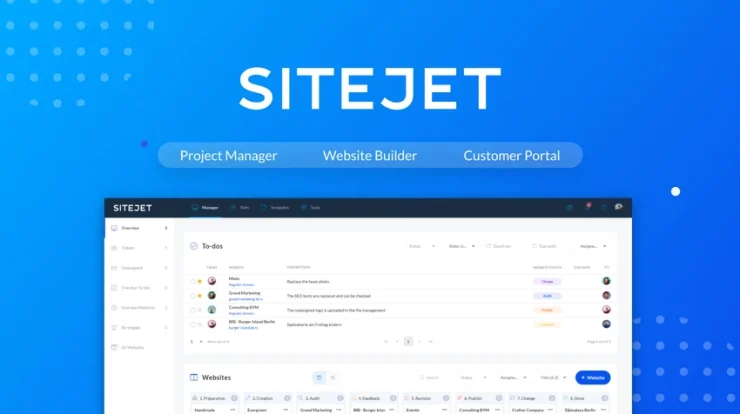
In a crowded landscape of website builders—ranging from beginner-friendly tools to complex CMS platforms—Sitejet has carved out a distinct niche. Rather than focusing solely on drag-and-drop simplicity or developer-level flexibility, Sitejet blends design, collaboration, hosting, and project management into a single ecosystem.
That positioning matters. Most website builders force users to juggle multiple tools: one for design, another for hosting, another for client feedback, and yet another for project tracking. Sitejet’s core philosophy is different—it aims to consolidate the entire workflow into one platform.
This blog post takes a deep dive into Sitejet, exploring its features and, more importantly, the key advantages it offers compared to other website builders like WordPress, Wix, Squarespace, and Webflow.
What Is Sitejet?
Sitejet is an all-in-one website builder designed for freelancers, agencies, and businesses. It combines a visual editor with advanced development tools, while also integrating hosting, SEO, and client collaboration features.
Unlike traditional platforms, Sitejet is available in two primary forms:
- A standalone website builder for individuals and small businesses
- A “Studio” version tailored for agencies managing multiple client projects
Its defining idea is simple: build, manage, and deliver websites without switching tools. (Sitejet)
Core Features of Sitejet
Before comparing it to competitors, it’s important to understand what Sitejet actually offers.
1. Visual Builder + Code-Level Control
Sitejet combines a drag-and-drop interface with full access to HTML, CSS, and JavaScript. (Sitejet)
This hybrid approach is significant:
- Beginners can design visually
- Developers can fine-tune code
Most builders force you to choose one or the other—Sitejet gives both.
2. Pre-Built Templates and Sections
With 170+ templates and 120+ pre-built sections, users can rapidly assemble websites. (Sitejet)
This dramatically reduces build time, especially for agencies working on multiple projects.
3. Built-In Project Management
One of Sitejet’s most unique features is its project management system:
- Task assignment
- Time tracking
- Status updates
- To-do lists (Sitejet)
This is almost unheard of in traditional website builders.
4. Client Collaboration Tools
Sitejet includes:
- A client portal
- Feedback tools
- Messaging systems
Clients can review designs and leave feedback directly on the site—eliminating long email threads. (Sitejet)
5. Integrated Hosting and Security
Sitejet offers:
- Built-in hosting
- CDN support
- SSL certificates
- DDoS protection
- Automated backups (Sitejet)
This removes the need for third-party hosting providers.
6. SEO and Performance Optimization
The platform includes:
- SEO settings per page
- Image compression
- Code minimization
- Lazy loading (Sitejet)
These features help improve site speed and search visibility.
7. AI-Powered Features
Sitejet includes AI tools such as:
- AI text generation
- Brand color detection from logos (Sitejet)
Additionally, newer integrations include AI-generated website layouts (as noted in community discussions).
Advantages of Sitejet Over Other Website Builders
Now let’s explore where Sitejet truly stands out.
1. All-in-One Workflow (Its Biggest Advantage)
Most website builders focus only on design.
Sitejet goes further by combining:
- Design
- Hosting
- Project management
- Client communication
This makes it fundamentally different from tools like:
- WordPress (requires plugins + hosting + tools)
- Wix (design-focused but limited workflow tools)
Why this matters:
Agencies often waste hours switching between tools like Trello, Slack, and email. Sitejet consolidates everything into one dashboard.
👉 Advantage: Massive time savings and operational efficiency
2. Built for Agencies (Not Just Individuals)
While platforms like Squarespace and Wix target individuals, Sitejet is clearly built for professional workflows.
Key agency-focused features:
- Multi-user roles and permissions
- White-label capabilities
- Client portals
- Revenue tracking dashboards (Sitejet)
👉 Advantage: Better scalability for freelancers and agencies
3. Integrated Client Feedback System
Client feedback is one of the biggest bottlenecks in web design.
Sitejet solves this with:
- On-page feedback tools
- Ticket systems for change requests
- Centralized communication (Sitejet)
Compare this to:
- WordPress → requires plugins or external tools
- Webflow → limited native collaboration
👉 Advantage: Streamlined client communication
4. Faster Development Through Automation
Sitejet includes automation features like:
- Corporate identity detection
- Pre-built components
- AI content generation (Sitejet)
These reduce repetitive tasks.
👉 Advantage: Faster turnaround times for projects
5. Built-In Hosting and Performance Optimization
Unlike WordPress, which requires separate hosting, Sitejet includes everything in one package:
- Hosting
- Security
- CDN
- Backups (Sitejet)
👉 Advantage: Simplified setup and maintenance
6. Balance Between Ease of Use and Flexibility
Some platforms are too simple:
- Wix → easy but restrictive
Others are too complex:
- Drupal → powerful but difficult
Sitejet sits in the middle:
- Visual editing for beginners
- Code access for developers (Sitejet)
👉 Advantage: Wider usability across skill levels
7. Strong Collaboration and Team Features
Sitejet includes:
- Team permissions
- Task assignments
- Time tracking (Sitejet)
Few builders offer this natively.
👉 Advantage: Improved team productivity
8. Centralized Dashboard for Multiple Projects
Managing multiple websites is often messy.
Sitejet provides:
- A unified dashboard
- Project status tracking
- Revenue monitoring (Sitejet)
👉 Advantage: Better project oversight
9. White-Label Capabilities
Agencies can brand Sitejet as their own platform.
👉 Advantage: Professional client experience and brand control
10. Strong Security and Reliability
Sitejet includes:
- Automated backups
- DDoS protection
- SSL encryption (Sitejet)
👉 Advantage: Enterprise-level security without extra setup
Where Sitejet Falls Short
To keep things realistic, Sitejet isn’t perfect.
According to reviews:
- The editor can have a learning curve for beginners
- Fewer templates compared to competitors
- Limited built-in marketing tools (TechRadar)
Some users also report occasional usability frustrations in community discussions, especially when customizing deeply.
Who Should Use Sitejet?
Sitejet is ideal for:
✅ Agencies and Freelancers
Its workflow tools and collaboration features are unmatched.
✅ Businesses Managing Multiple Websites
The dashboard and project tracking simplify operations.
✅ Designers Who Want Flexibility
Visual builder + code editing is a powerful combo.
Who Might Prefer Other Builders?
- Beginners wanting extreme simplicity → Wix
- Content-heavy sites → WordPress
- Advanced custom web apps → Webflow
Final Thoughts
Sitejet isn’t just another website builder—it’s a workflow platform for building and managing websites at scale.
Its biggest advantage is clear:
👉 It eliminates the fragmentation that defines most web development workflows.
Instead of stitching together tools for design, hosting, collaboration, and project management, Sitejet brings everything under one roof.
That makes it especially powerful for professionals who:
- Build websites regularly
- Work with clients
- Manage multiple projects
While it may not be the simplest builder on the market, it offers something arguably more valuable: efficiency, control, and scalability.
And in today’s fast-paced digital environment, those advantages can make all the difference.

With 23+ years in the Web Hosting Industry, Brian has had the opportunity to design websites for some of the largest companies in the industry. Brian currently holds the position as Co-Founder and Creative Director at WebHosting,coop Internet Cooperative