
Introduction: Why Traffic Management Matters More Than Ever
As companies grow, one of the first invisible problems they encounter is not design, marketing, or even product—it is traffic. More specifically, it is the sudden realization that a single server or a small cluster of servers can only handle so much demand before performance begins to degrade.
Pages load slowly. APIs time out. Users experience inconsistent service. In worst cases, systems go completely offline under heavy load.
This is where server redundancy and load balancers become essential. They are not optional “enterprise upgrades”—they are foundational infrastructure patterns that allow modern applications to remain stable, responsive, and scalable.
At a high level, redundancy ensures that systems remain available even when parts fail. Load balancers ensure that incoming traffic is distributed efficiently across available resources.
Together, they form the backbone of reliable, high-performance systems.
Understanding Server Redundancy
Server redundancy is the practice of maintaining multiple systems that can perform the same function so that if one fails, another can take over without disruption.
Instead of relying on a single server to handle requests, redundant architectures distribute responsibility across multiple machines.
There are several forms of redundancy:
Active-Active Redundancy
Multiple servers are running simultaneously, sharing traffic at all times. If one server fails, the others continue handling requests seamlessly.
Active-Passive Redundancy
One server handles all traffic while another remains on standby. If the primary server fails, the backup server becomes active.
Geographic Redundancy
Servers are distributed across multiple data centers or regions. This protects against localized outages such as power failures, natural disasters, or network disruptions.
The core idea is simple: no single machine should be a single point of failure.
Without redundancy, even a minor hardware issue can take an entire system offline.
What a Load Balancer Actually Does
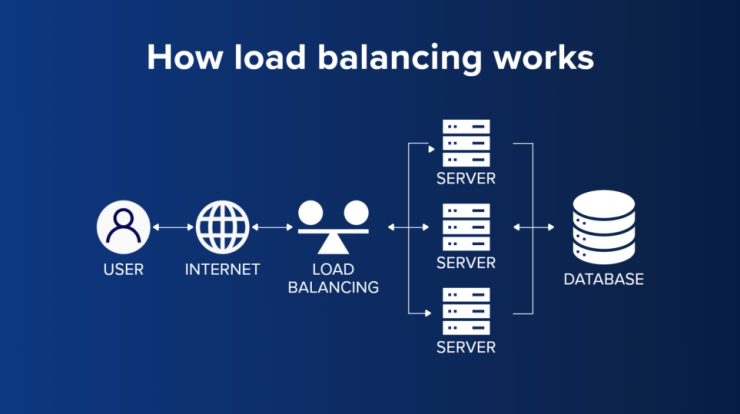
A load balancer is a system that distributes incoming network traffic across multiple servers.
Instead of users connecting directly to one server, they connect to a load balancer, which then decides where to route each request.
This helps achieve three key goals:
- Preventing overload on any single server
- Improving response time and performance
- Increasing system availability and reliability
Load balancers operate at different layers of the network:
Layer 4 (Transport Layer)
These load balancers route traffic based on IP address and TCP/UDP ports. They are fast and efficient but less aware of application-level details.
Layer 7 (Application Layer)
These load balancers inspect HTTP requests and can route traffic based on content such as URLs, headers, or cookies. They are more flexible but slightly more resource-intensive.
Together, these approaches allow systems to scale intelligently depending on the type of application.
How Load Balancers Mitigate Traffic
When traffic increases, load balancers prevent system failure by distributing requests across multiple servers.
Instead of one server receiving 100,000 requests per second, a load balancer might distribute those requests across 10 servers, each handling 10,000.
This reduces strain, prevents bottlenecks, and maintains consistent performance.
Load balancers also monitor server health. If a server becomes slow or unresponsive, it is automatically removed from rotation until it recovers.
This process is known as health checking.
So even if a server is still technically running, it will not receive traffic if it is performing poorly.
This creates a dynamic system that adapts in real time.
The Role of Redundancy in Failover Protection
Load balancing alone is not enough. Redundancy ensures continuity when failures occur.
If a server crashes, redundancy ensures that another server is already available to take over its workload.
This is critical in environments where downtime is expensive.
For example:
- E-commerce platforms lose revenue every second they are offline
- SaaS platforms risk breaking user workflows
- APIs supporting external systems can cascade failures into other services
Redundancy eliminates the “single point of failure” problem by ensuring that no single machine is essential for system survival.
Popular Load Balancing Technologies
Modern infrastructure relies on a variety of tools and services for load balancing.
NGINX
NGINX is widely used as both a web server and a reverse proxy load balancer. It can distribute traffic across multiple backend servers and is known for high performance and efficiency.
HAProxy
HAProxy is one of the most established load balancing solutions. It supports both Layer 4 and Layer 7 load balancing and is known for stability under heavy traffic loads.
Cloud-Based Load Balancers
Many cloud providers offer managed load balancing services that automatically scale and integrate with infrastructure.
For example, Amazon Web Services provides Elastic Load Balancing, which automatically distributes incoming application traffic across multiple targets such as EC2 instances and containers.
These services reduce operational complexity while improving reliability.
How Cloud Infrastructure Enhances Scalability
Modern cloud platforms have made redundancy and load balancing significantly easier to implement.
Instead of manually configuring hardware, companies can now deploy scalable infrastructure through managed services.
For example:
- Servers can be automatically added or removed based on demand
- Traffic can be routed across multiple regions
- Health checks can automatically replace failing instances
Cloud providers such as Amazon Web Services and Cloudflare provide global infrastructure that allows businesses to scale without building physical data centers.
This shift has made enterprise-level reliability accessible to startups and small companies.
Why Load Balancers Are Critical for Growth
In early-stage systems, a single server may be enough. Traffic is low, and simplicity is more important than scale.
However, as a company grows, traffic becomes unpredictable.
A successful marketing campaign, viral post, or product launch can multiply traffic overnight.
Without a load balancer:
- Servers can crash under sudden spikes
- Users experience slow or failed requests
- System instability damages trust and reputation
With a load balancer:
- Traffic is distributed evenly
- No single server becomes overloaded
- Systems remain stable under fluctuating demand
This is why load balancers are not just performance tools—they are business continuity tools.
Advantages of Server Redundancy and Load Balancing
The combination of redundancy and load balancing provides several major advantages.
1. High Availability
Systems remain operational even when individual components fail. This is essential for services that require 24/7 uptime.
2. Scalability
As traffic increases, additional servers can be added without redesigning the system.
3. Fault Tolerance
Failures in hardware or software do not cause full system outages.
4. Improved Performance
Traffic distribution reduces server strain and improves response times.
5. Better User Experience
Users experience fewer errors, faster load times, and more consistent service quality.
6. Maintenance Flexibility
Servers can be updated or restarted without taking the entire system offline.
These advantages are not incremental—they fundamentally change how systems behave under stress.
Real-World Example of Traffic Mitigation
Consider an online platform that suddenly goes viral.
Without load balancing:
- One server receives overwhelming traffic
- CPU and memory usage spike
- Requests begin to fail
- The server crashes
With load balancing and redundancy:
- Incoming traffic is distributed across multiple servers
- No single server becomes overwhelmed
- If one server fails, others continue operating
- Users experience minimal disruption
The difference is not just technical—it directly affects revenue, reputation, and user trust.
The Relationship Between Load Balancers and Modern Architecture
Modern architectures like microservices and containerized systems rely heavily on load balancing.
In these environments, services are broken into smaller components that communicate over networks.
A load balancer ensures that:
- Requests reach the correct service
- No service instance becomes overloaded
- Scaling can occur independently per service
Orchestration platforms like Kubernetes also include built-in load balancing mechanisms to distribute traffic across containers dynamically.
This reflects a broader architectural shift: systems are no longer monolithic—they are distributed by design.
Why You Should Implement These Early
One of the most common mistakes growing companies make is waiting too long to implement redundancy and load balancing.
They often assume:
“We’ll add that when we need it.”
But in practice, “when we need it” often arrives suddenly and unpredictably.
Implementing these systems early provides several long-term benefits:
- Infrastructure is already prepared for growth
- Scaling becomes smoother and less risky
- System design decisions remain flexible
- Downtime risk is significantly reduced
It is far easier to build with scalability in mind than to retrofit it later under pressure.
Conclusion: Building Systems That Can Grow Without Breaking
Server redundancy and load balancers are not advanced luxuries—they are foundational components of any serious digital system.
They ensure that applications remain available, responsive, and resilient even under unpredictable conditions.
Redundancy protects against failure. Load balancing protects against overload. Together, they create systems that are stable under pressure and scalable over time.
As companies grow, the importance of these systems only increases. Traffic becomes less predictable, user expectations become higher, and downtime becomes more expensive.
By implementing redundancy and load balancing early, businesses do more than improve performance—they protect their ability to scale.
In modern infrastructure, success is not just about building something that works.
It is about building something that keeps working when demand increases, when systems fail, and when growth happens faster than expected.

With 23+ years in the Web Hosting Industry, Brian has had the opportunity to design websites for some of the largest companies in the industry. Brian currently holds the position as Co-Founder and Creative Director at WebHosting,coop Internet Cooperative