
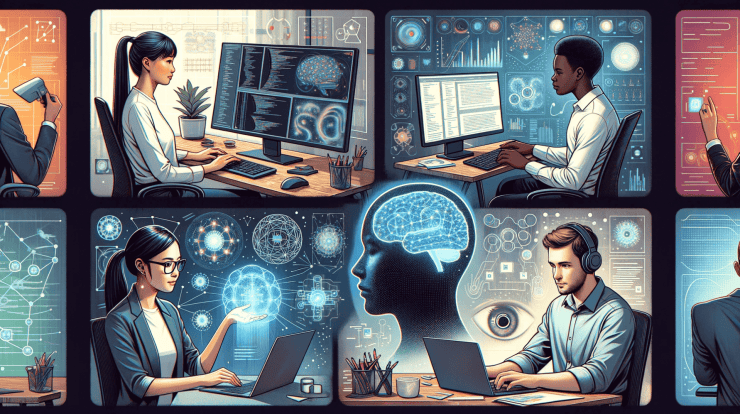
How Artificial Intelligence Is Transforming the World of Work
Artificial intelligence is changing how people live, work, communicate, and do business. From intelligent virtual assistants and automated customer service to self-driving vehicles and advanced medical research, AI is becoming an important part of nearly every industry. As these technologies continue to improve, they will transform existing careers, automate certain tasks, and create entirely new professions that were difficult to imagine just a few years ago.
Although discussions about AI often focus on jobs that could disappear, there is another side to this transformation: the jobs that artificial intelligence will create. Companies will need people who can build AI systems, maintain the infrastructure that powers them, protect them from security threats, evaluate their results, and apply them to real-world problems. Other opportunities will emerge in education, healthcare, manufacturing, entertainment, transportation, finance, and many additional fields.
For students, professionals, and people considering a career change, understanding these developments is becoming increasingly important. Preparing for the future does not necessarily mean earning an advanced computer science degree. Depending on the career, it may involve studying programming, mathematics, cybersecurity, engineering, design, healthcare, business, or a skilled trade.
The most important goal is to develop skills that complement artificial intelligence rather than relying entirely on tasks that automated systems can perform. People who combine technical knowledge with creativity, critical thinking, communication, and practical experience may be especially well positioned to take advantage of the opportunities ahead.
1. How Artificial Intelligence Will Create New Jobs
Artificial intelligence creates employment opportunities in several different ways. The first is through the development of AI technology itself. Advanced systems require software engineers, researchers, data specialists, infrastructure engineers, and other professionals who can build and improve them.
The second is through the adoption of AI by existing businesses. A hospital introducing AI-assisted diagnostic tools may need technology specialists, data governance professionals, cybersecurity experts, and staff members who understand how to integrate these systems into clinical workflows. A retailer using AI to manage inventory may need automation engineers and analysts who can ensure that its systems operate accurately.
The third opportunity comes from entirely new products and services. Entrepreneurs may create businesses around personalized education, automated marketing, intelligent design tools, robotics, digital assistants, and specialized AI applications for industries that have historically relied on manual processes.
Finally, AI will create demand for professionals who can manage the relationship between people and automated systems. Businesses will need employees who can determine when AI should be used, identify when its output is unreliable, protect sensitive information, and ensure that automated decisions follow legal and ethical requirements.
Some existing jobs will shrink or change as automation spreads, and not every new role will replace a displaced position on a one-to-one basis. The transition will vary by industry, region, and occupation. Nevertheless, learning how AI works and how to use it effectively can help workers adapt as employers change their operations.
2. Artificial Intelligence Engineer
One of the most recognizable careers in the AI economy will be artificial intelligence engineering. AI engineers develop, implement, and maintain systems that can perform tasks such as recognizing images, processing language, making predictions, and generating content.
These professionals work with machine learning models, large language models, recommendation systems, computer vision, and other AI technologies. They may develop intelligent customer service applications, automate business processes, create personalized software experiences, or help machines understand information from the physical world.
To prepare for this career, students should consider studying computer science, software engineering, mathematics, and statistics. Programming languages such as Python are particularly useful because they are widely used in machine learning and data science. Knowledge of algorithms, databases, APIs, cloud computing, and software testing is also valuable.
Students should eventually become familiar with machine learning frameworks, model evaluation, and the process of deploying AI applications into production environments.
A degree in computer science or a related field can provide a strong foundation, although practical projects, specialized training, and relevant experience can also contribute to a candidate’s qualifications.
People entering this profession should build a portfolio demonstrating that they can solve real problems. Examples include developing a document-search assistant, building an image classification system, or creating a tool that analyzes business information.
3. Machine Learning Engineer
Machine learning engineers focus on building systems that learn patterns from data and use those patterns to make predictions or perform tasks.
While AI engineering and machine learning engineering overlap, machine learning engineers often spend more time developing training pipelines, selecting model architectures, improving accuracy, and ensuring that models continue to perform reliably after deployment.
Businesses use machine learning for fraud detection, product recommendations, demand forecasting, predictive maintenance, medical research, and many other applications.
Students interested in this career should study programming, linear algebra, calculus, probability, statistics, and optimization. Python is an important language, while experience with data-processing tools, machine learning libraries, cloud platforms, and distributed computing can provide additional advantages.
Another important area is MLOps, which combines machine learning with software deployment and operational practices. Organizations need professionals who can monitor models, identify performance problems, manage updates, and ensure that AI systems remain dependable.
As companies move from AI experimentation to real business applications, engineers who can operate these systems reliably will be increasingly valuable.
4. Data Scientist and Data Engineer
Artificial intelligence depends on data. Without useful, accurate, and appropriately managed information, even sophisticated models can produce unreliable results.
Data scientists analyze information to discover patterns, test hypotheses, make forecasts, and help organizations make better decisions. They may investigate customer behavior, identify manufacturing problems, evaluate advertising campaigns, or develop predictive models.
Data engineers have a related but different responsibility: they build and maintain the systems that collect, organize, transform, and deliver data to the people and applications that need it.
Preparing for these careers typically involves studying statistics, mathematics, computer science, database management, and data visualization. Python, SQL, spreadsheets, and business intelligence tools are useful starting points.
More advanced positions may require experience with cloud data platforms, data pipelines, distributed processing, and machine learning.
Students should also learn how to interpret results rather than simply produce charts or predictions. Understanding data quality, sampling bias, privacy, and the limitations of statistical analysis is essential.
AI can automate some routine analytical tasks, but organizations still need professionals who understand which questions to ask, whether the evidence supports a conclusion, and how the findings should influence real decisions.
5. AI Cybersecurity Specialist
As businesses rely more heavily on artificial intelligence, cybersecurity will become even more important. AI systems can introduce new vulnerabilities, expose sensitive information, and create opportunities for attackers to manipulate automated processes.
Cybersecurity specialists protect networks, software, databases, cloud infrastructure, and AI applications from unauthorized access and malicious activity.
An emerging specialization involves AI security. Professionals in this area may test models for vulnerabilities, investigate prompt injection attacks, prevent sensitive information from leaking through AI applications, and protect the systems that connect AI models to company databases and other tools.
Another related area is AI red teaming, in which specialists deliberately test AI systems to identify unsafe behavior, security weaknesses, and ways a system could be manipulated.
Students should study computer science, cybersecurity, networking, operating systems, secure programming, and cloud security. Familiarity with identity management, encryption, incident response, and vulnerability assessment can also be useful.
People interested in this field should practice in authorized training environments and learn responsible security testing techniques.
As AI becomes integrated into financial services, healthcare, government, and critical infrastructure, protecting these systems will be a major technical and organizational responsibility.
6. Robotics Engineer and AI Automation Specialist
Artificial intelligence is not limited to computers and websites. It is also helping machines interact with the physical world. Robots can increasingly recognize objects, navigate environments, assist with manufacturing, and perform tasks that once required direct human control.
Robotics engineers design, build, program, and test these machines. AI automation specialists focus on using intelligent software and hardware to make business processes more efficient.
Potential applications include warehouse robots, agricultural automation, manufacturing equipment, delivery systems, medical robotics, and machines that inspect dangerous environments.
Students interested in robotics should consider studying mechanical engineering, electrical engineering, computer engineering, robotics, and computer science. Useful technical subjects include physics, calculus, control systems, electronics, sensors, and programming.
Python and C++ are valuable languages in robotics, while knowledge of computer vision, embedded systems, and robotic operating environments can help students develop practical skills.
There will also be opportunities for technicians who install, maintain, repair, and troubleshoot automated equipment. These positions may be accessible through technical colleges, apprenticeships, vocational programs, or engineering degrees, depending on the role.
As automation expands, the workforce will need people who understand both the technology and the physical environments in which it operates.
7. AI Product Manager and AI Business Consultant
Not every future AI career will require advanced programming. Companies also need professionals who understand business problems and can determine how artificial intelligence might solve them.
AI product managers guide the development of AI-powered products. They help define product requirements, prioritize features, coordinate engineering teams, evaluate user feedback, and measure whether a product delivers meaningful results.
AI business consultants help organizations identify opportunities to introduce automation, improve workflows, reduce unnecessary costs, and develop new services.
These professionals must understand what AI can do, where it performs poorly, and when a conventional solution might be more appropriate.
Students can prepare by studying business administration, information systems, economics, product management, or computer science. Courses in data analytics, project management, statistics, and AI fundamentals can provide additional preparation.
Communication is especially important because these professionals often translate technical concepts into language that executives, employees, and customers can understand.
Someone who understands both business operations and AI technology can help an organization move beyond experimenting with chatbots and toward implementing useful, measurable improvements.
8. AI Ethics, Governance, and Compliance Specialist
Artificial intelligence raises important questions about privacy, fairness, accountability, transparency, and safety. Organizations need people who can help ensure that AI systems are used responsibly and comply with applicable laws and regulations.
AI governance specialists develop policies for how organizations select, evaluate, deploy, and monitor AI systems. They may establish rules for handling confidential information, documenting automated decisions, reviewing model performance, and determining when human approval is necessary.
AI auditors and risk specialists examine whether systems behave as expected, identify potential harms, and evaluate the controls organizations have established.
Students interested in this career can study information technology, law, public policy, philosophy, business, cybersecurity, or data science. Combining one of these subjects with AI governance and privacy training can be particularly useful.
Important topics include data protection, algorithmic bias, risk assessment, documentation, intellectual property, and regulatory compliance.
This field illustrates why the future of AI will require more than engineers. Organizations also need professionals who can evaluate the consequences of technological decisions and help establish appropriate safeguards.
9. AI Healthcare and Biotechnology Careers
Healthcare is another field in which AI may create significant opportunities. AI systems can help researchers analyze medical images, identify patterns in health data, discover potential drug candidates, and support administrative tasks.
However, healthcare applications require careful validation, professional oversight, and protection of sensitive patient information.
Potential careers include biomedical data scientist, computational biologist, AI-assisted medical imaging specialist, bioinformatics engineer, and healthcare AI implementation specialist.
Students interested in these opportunities should consider biology, chemistry, medicine, biomedical engineering, statistics, computer science, or bioinformatics.
For computational biology, programming and mathematics can help researchers analyze large biological datasets. For healthcare technology implementation, knowledge of clinical workflows, information systems, privacy, and AI evaluation may be more directly relevant.
AI will not eliminate the need for healthcare professionals. Doctors, nurses, therapists, and other clinicians provide human judgment, communication, and care that cannot be reduced to automated predictions alone.
Instead, many healthcare workers may increasingly use AI as an additional tool, while new specialists help develop and evaluate systems designed to support medical research and patient care.
10. AI Designers, Creative Professionals, and Digital Content Specialists
Artificial intelligence is transforming graphic design, web development, animation, music production, video editing, marketing, and digital content creation.
AI-powered tools can generate initial design concepts, assist with image editing, create video drafts, suggest layouts, and accelerate repetitive production tasks. This does not mean creative professionals will no longer be needed. It means their responsibilities may shift toward directing tools, refining results, solving communication problems, and creating distinctive experiences.
New opportunities may include AI experience designer, generative media specialist, AI-assisted animator, creative automation specialist, and conversational interface designer.
Students should consider studying graphic design, UX/UI design, web development, animation, digital media, marketing, and human-computer interaction.
Technical skills such as HTML, CSS, JavaScript, design systems, accessibility, and prototyping remain useful for people building digital products. Familiarity with image-generation systems, video tools, and AI-assisted coding can expand a creative professional’s capabilities.
The most successful designers will need more than the ability to generate attractive images. They must understand audiences, usability, visual communication, branding, and the business goals behind a project.
AI can produce many variations quickly, but deciding which variation is appropriate still requires judgment and a clear understanding of the problem being solved.
11. AI Teachers, Trainers, and Learning Specialists
Education may also experience a major transformation as AI makes personalized learning more accessible.
AI-powered educational tools can explain difficult concepts, generate practice exercises, provide feedback, and adjust lessons to a student’s progress. Schools, universities, and businesses will need people who can integrate these tools into effective learning experiences.
Possible careers include AI learning experience designer, educational technology specialist, AI curriculum developer, corporate AI trainer, and instructional designer.
Students interested in these roles can study education, instructional design, psychology, learning sciences, computer science, or educational technology.
Teachers and trainers will also need to understand how to use AI responsibly, recognize inaccurate answers, protect student information, and encourage learners to develop their own reasoning skills.
As businesses adopt AI, employee training could become a particularly important area. Workers may need regular instruction on new software, automated workflows, data protection, and the responsible use of AI tools.
Professionals who can explain complicated technology in practical, accessible ways will help organizations adapt to changing workplace expectations.
12. AI Infrastructure, Cloud Computing, and Data Center Careers
AI systems require substantial computing infrastructure. Large-scale models depend on specialized processors, storage systems, high-speed networking, cloud platforms, and reliable electricity and cooling.
This creates opportunities beyond AI research and software development.
Potential careers include cloud engineer, data center technician, AI infrastructure engineer, network engineer, hardware engineer, and data center energy-efficiency specialist.
Students can prepare by studying information technology, computer engineering, electrical engineering, networking, cloud computing, or industrial maintenance.
Certifications and hands-on training can help candidates demonstrate practical knowledge of networking, operating systems, server administration, and cloud platforms.
Electricians, cooling-system technicians, equipment installers, and other skilled tradespeople may also contribute to the construction and maintenance of facilities that support AI infrastructure.
These careers demonstrate that the AI economy will need both digital expertise and physical infrastructure. People who prefer working with equipment, electrical systems, or mechanical components may find promising opportunities without pursuing a traditional software engineering career.
13. What Should Students Study to Prepare for the Future?
There is no single educational path that guarantees success in an AI-driven economy. The best choice depends on a student’s interests, strengths, financial circumstances, and desired career.
Nevertheless, several subjects can provide a strong foundation.
Computer science and programming: Learn how software works, how to solve problems using code, and how applications communicate with databases and other systems. Python is a strong starting point for AI, while JavaScript is useful for web development and interactive applications.
Mathematics and statistics: Algebra, probability, statistics, and eventually linear algebra and calculus are valuable for people pursuing technical AI careers. Not every AI-related profession requires advanced mathematics, but quantitative reasoning helps workers evaluate data and predictions.
Data analysis: Learn how to collect, organize, interpret, and visualize information. SQL, spreadsheets, and Python-based data tools are useful skills across many industries.
Cybersecurity and privacy: Understand networks, authentication, encryption, secure software development, and responsible data handling. These subjects are valuable wherever organizations rely on digital systems.
Engineering and skilled trades: Electrical systems, mechanical engineering, robotics, HVAC, industrial maintenance, and electronics can prepare students to work with the physical infrastructure and machinery used in AI-enabled businesses.
Business and communication: Learn project management, economics, marketing, writing, negotiation, and organizational problem-solving. AI projects often fail to deliver value when organizations do not understand the underlying business problem.
Design and human-computer interaction: Study user research, accessibility, visual design, usability testing, and interface development if you want to build products that people can use effectively.
Students should also develop critical thinking, adaptability, collaboration, and ethical judgment. These skills help people recognize mistakes, question unsupported conclusions, communicate with colleagues, and make decisions in unfamiliar situations.
14. How to Start Learning AI Without Spending a Fortune
A university degree can be valuable, particularly for research, advanced engineering, and specialized scientific roles. However, people can begin learning many AI skills through affordable online courses, community colleges, public educational resources, and independent projects.
Start by learning basic programming and the fundamentals of AI. Experiment with AI tools, but do not stop at writing prompts. Learn how applications use APIs, how data is processed, how results are evaluated, and how to identify inaccurate outputs.
Next, choose a career direction. Someone interested in cybersecurity should practice networking and defensive security. An aspiring AI designer should build interface prototypes and demonstrate how AI can improve a user experience. Someone interested in data science should learn statistics and create projects that analyze real datasets.
Build a portfolio that shows what you can accomplish. A useful project might be an AI assistant that searches a collection of documents, a dashboard that analyzes business trends, or an automated workflow that reduces repetitive administrative work.
Document the problem, your approach, the tools you used, the limitations you discovered, and the results. Employers need evidence that candidates can apply knowledge to practical challenges.
Finally, keep learning. AI tools, programming frameworks, and workplace expectations change quickly. Regular practice and ongoing education can help workers keep their skills relevant.
Conclusion: Preparing for an AI-Powered Future
Artificial intelligence will reshape the employment landscape, but the future is not simply a choice between humans and machines. It will also involve people working alongside intelligent systems, building new technologies, solving problems that automation creates, and finding new ways to deliver value.
AI engineers, machine learning specialists, data scientists, cybersecurity professionals, robotics engineers, healthcare researchers, designers, educators, business consultants, and infrastructure technicians represent just some of the career paths that may expand as adoption grows.
At the same time, some existing occupations will experience disruption, and new opportunities will not appear equally in every region or industry. No career title is guaranteed to grow indefinitely, so students should evaluate actual employer demand and the qualifications required for their chosen field.
The strongest preparation combines relevant technical knowledge with practical experience, communication, creativity, and the ability to keep learning. You do not have to become an AI researcher to benefit from the AI revolution. You can apply AI within a profession you already enjoy, develop expertise in a technical specialty, or pursue a skilled trade that supports the technology’s physical infrastructure.
The future belongs neither exclusively to people who can write code nor to those who simply know how to operate an AI tool. It will offer opportunities to people who understand meaningful problems, use technology thoughtfully, and turn ideas into useful results.
The best time to prepare for the jobs of the future is now. Identify a field that interests you, learn the skills employers need, build practical projects, and stay curious. Artificial intelligence is changing the world of work, and the people who prepare thoughtfully will be better equipped to help shape what comes next.
14 Artificial Intelligence Careers & Job Outlook [2026]

With 23+ years in the Web Hosting Industry, Brian has had the opportunity to design websites for some of the largest companies in the industry. Brian currently holds the position as Co-Founder and Creative Director at WebHosting,coop Internet Cooperative