
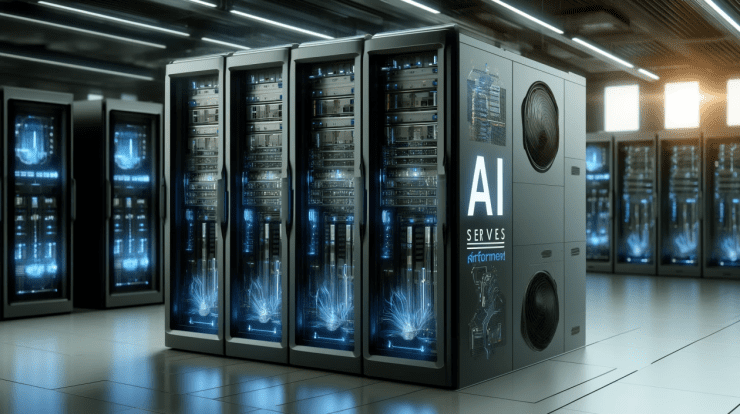
The web hosting industry is going through one of the biggest transformations since the rise of cloud computing. For years, hosting companies competed on storage space, bandwidth, uptime guarantees, and price. Today, artificial intelligence is reshaping nearly every part of the hosting ecosystem, from server management and cybersecurity to customer support and website optimization.
AI is no longer just a feature added onto hosting platforms. It is becoming the foundation that powers modern infrastructure. Hosting providers are using machine learning systems to predict server failures before they happen, automatically scale resources during traffic spikes, detect cyberattacks in real time, and even build websites automatically for customers with little technical knowledge.
The result is a smarter, faster, and more automated hosting environment that changes how websites are built, managed, and secured. Businesses, developers, and beginners are all starting to benefit from AI-powered hosting technologies.
According to industry reports, AI-driven automation, edge computing, cloud-native infrastructure, and sustainability initiatives are becoming major priorities for hosting providers worldwide. =
The Shift From Traditional Hosting to Intelligent Hosting
Traditional web hosting relied heavily on manual management. System administrators had to monitor servers, allocate resources, troubleshoot issues, install updates, and respond to outages manually. If a website suddenly received a spike in traffic, the server might crash before anyone noticed.
AI changes this process dramatically.
Modern hosting systems can analyze enormous amounts of server data in real time. AI algorithms study traffic patterns, CPU usage, storage consumption, memory allocation, and user behavior. Instead of reacting after problems occur, the system predicts issues before they become serious.
This predictive approach is becoming one of the biggest changes in hosting.
For example, an AI-powered hosting platform can notice that a website receives heavy traffic every Friday evening. The system can automatically allocate more resources before the traffic surge begins. Once traffic decreases, the server scales back down automatically. This reduces downtime and saves money at the same time.
Hosting companies are increasingly using AI-supported auto-scaling, anomaly detection, and self-healing operations to improve uptime and reduce operational costs.
The hosting industry is moving away from static servers toward dynamic infrastructure that constantly adapts itself.
AI-Powered Website Builders
One of the most visible changes in hosting is the rise of AI website builders.
In the past, building a website often required learning HTML, CSS, WordPress, or hiring a web designer. AI website builders simplify the process dramatically. Users can now describe their business in plain English, and AI tools generate layouts, content, images, navigation menus, and color schemes automatically.
Many hosting companies now include AI website creation tools directly inside their hosting dashboards.
For example, a restaurant owner might type:
“Create a website for an Italian restaurant with online reservations and a modern design.”
Within minutes, AI can generate an entire functioning website.
This lowers the barrier to entry for beginners and small businesses. It also changes the role of hosting providers. Instead of simply renting server space, hosting companies are becoming full-service AI-powered digital platforms.
AI-driven search visibility is also changing competition among hosting companies and website builders. Recent industry reporting shows platforms with strong AI integrations are becoming more visible in AI-powered search systems. (TechRadar)
AI and Automated Server Management
Server management has traditionally been complicated and time-consuming. Administrators needed deep technical expertise to configure servers, monitor performance, install security patches, and optimize databases.
AI is automating many of these tasks.
Modern hosting platforms can now:
- Detect unusual server behavior automatically
- Restart crashed services without human intervention
- Optimize databases automatically
- Recommend server upgrades
- Balance workloads across multiple machines
- Predict hardware failures
- Detect resource bottlenecks before they affect users
This trend is often referred to as “AIOps,” which stands for Artificial Intelligence for IT Operations.
Instead of humans constantly monitoring systems, AI systems continuously analyze infrastructure performance.
Some hosting companies are now building “self-healing” infrastructure. If a server experiences problems, AI systems can automatically redirect traffic, isolate failures, restart applications, or migrate workloads to healthier servers.
This creates more reliable hosting environments with less downtime.
Industry reports show AI automation is becoming one of the largest innovation opportunities for hosting providers in 2026 and beyond.
AI-Powered Cybersecurity
Cybersecurity is becoming one of the most important uses of AI in hosting.
Traditional security systems relied heavily on static rules. For example, a firewall might block traffic from a suspicious IP address or stop requests that match known attack patterns.
The problem is that cyberattacks evolve constantly. AI-powered attacks can change behavior rapidly, making traditional defenses less effective.
AI-driven security systems can analyze behavior patterns instead of relying only on predefined rules.
For example, AI systems can detect:
- Unusual login attempts
- Suspicious traffic spikes
- Bot attacks
- Malware activity
- Distributed denial-of-service attacks
- Abnormal API requests
- Brute-force password attacks
Instead of simply blocking known threats, AI can identify new threats based on behavior anomalies.
Research on CDN-enhanced defenses shows AI-powered edge security systems are improving detection and mitigation times while reducing data movement and improving compliance.
Some hosting providers are already using machine learning systems to monitor millions of requests in real time. These systems can automatically isolate malicious traffic before websites are affected.
AI-powered security analytics are becoming especially important for VPS hosting and enterprise cloud hosting environments.
One Reddit user discussing AI-powered VPS hosting noted:
This shift toward adaptive security is likely to become standard across the hosting industry.
The Rise of Edge Hosting
AI is also accelerating the growth of edge hosting and edge computing.
Traditional hosting usually relies on centralized data centers. If a website visitor in Florida accesses a server located in Europe, latency increases because the data must travel a long distance.
Edge hosting moves content and computing closer to users.
Instead of relying on one central server, edge networks distribute workloads across many smaller locations around the world.
AI helps determine where workloads should run for maximum efficiency.
For example:
- AI can predict where traffic demand will increase
- AI can route visitors to the fastest server
- AI can cache content intelligently
- AI can reduce latency dynamically
This becomes especially important for:
- AI-powered applications
- Real-time gaming
- Video streaming
- Autonomous systems
- Smart devices
- IoT platforms
- Voice assistants
Industry experts increasingly view edge computing as a major trend shaping the future of hosting infrastructure.
Academic research also shows AI-enhanced edge systems can improve latency, bandwidth efficiency, and overall responsiveness.
The future internet will likely rely heavily on edge-based AI hosting environments.
AI Hosting for AI Applications
Another major trend is the emergence of hosting specifically designed for AI workloads.
Running AI models requires different hardware than traditional websites. AI applications often need:
- GPU acceleration
- High-speed storage
- Massive memory capacity
- Fast networking
- Specialized AI frameworks
Because of this, many hosting providers now offer “AI hosting” services.
These platforms provide preconfigured environments optimized for machine learning applications, AI chatbots, generative AI tools, and inference engines.
Some providers market GPU-powered VPS servers specifically for AI developers.
There is debate within the hosting community about whether “AI hosting” is truly new or simply a rebranding of high-performance cloud infrastructure.
Still, many developers find value in AI-ready environments that reduce setup complexity.
One Reddit discussion summarized it this way:
As AI adoption grows, hosting companies will increasingly compete on AI infrastructure capabilities.
AI Customer Support and Chatbots
Customer support is another area changing rapidly because of AI.
Web hosting companies traditionally relied on large technical support teams to answer tickets and troubleshoot customer issues.
AI-powered chatbots are now handling many support requests automatically.
Modern AI support systems can:
- Diagnose common hosting problems
- Help customers configure domains
- Explain DNS settings
- Troubleshoot WordPress errors
- Recommend hosting upgrades
- Guide users through migrations
- Detect server issues instantly
AI support systems are becoming increasingly sophisticated because they can analyze historical support data and learn from previous customer interactions.
This helps hosting companies reduce costs while improving response times.
Some platforms now provide near-instant troubleshooting assistance 24 hours a day.
For beginners, this makes hosting far less intimidating.
AI and Green Hosting
AI is also influencing the future of green hosting and sustainable infrastructure.
Data centers consume enormous amounts of electricity. The rise of AI workloads increases energy demand even further.
Industry analysts note that AI growth is driving major increases in data center power consumption and cooling requirements.
To address this, hosting companies are investing in:
- AI-powered energy optimization
- Smarter cooling systems
- Renewable energy integration
- Efficient workload balancing
- Low-energy hardware
- Dynamic resource allocation
AI can optimize server utilization to reduce wasted energy.
For example, instead of leaving servers running at low utilization constantly, AI systems can consolidate workloads onto fewer machines during low-demand periods.
Green hosting providers are also using AI to improve efficiency and sustainability goals. (webhosting)
Sustainability is becoming a competitive advantage in hosting.
Customers increasingly care about whether their websites are powered by renewable energy and environmentally responsible infrastructure.
Personalized Hosting Plans
AI is also changing how hosting plans are sold and managed.
Traditional hosting packages were rigid. Customers selected fixed plans with specific amounts of RAM, storage, and bandwidth.
AI enables far more personalized hosting environments.
Machine learning systems can analyze customer behavior and recommend optimal hosting configurations automatically.
This creates:
- Personalized pricing
- Dynamic resource allocation
- Usage-based billing
- Predictive scaling
- Custom infrastructure recommendations
Some hosting companies now use AI to forecast future customer needs before customers even realize they need upgrades.
For example, if a website begins growing rapidly, AI systems can recommend infrastructure upgrades proactively instead of waiting for performance issues.
This makes hosting more flexible and efficient.
The Future of AI Agents and Hosting
One of the most fascinating developments is the idea of AI-native hosting environments.
Instead of hosting traditional websites, future hosting platforms may primarily host AI agents.
AI agents are autonomous software systems capable of performing tasks, interacting with APIs, analyzing information, and making decisions independently.
Industry leaders increasingly believe the internet is shifting from static pages toward AI-driven systems and autonomous agents.
This could fundamentally reshape hosting infrastructure.
Future hosting environments may need to support:
- Persistent AI agents
- Continuous inference workloads
- Autonomous workflows
- AI-to-AI communication
- Agent marketplaces
- AI-native cloud architecture
Hosting providers may evolve into platforms optimized for intelligent software rather than traditional websites.
This is a major shift in how the internet itself operates.
AI and the End of Basic Shared Hosting
AI may also accelerate the decline of traditional low-cost shared hosting.
Modern websites are becoming more demanding. They rely on APIs, real-time applications, AI integrations, advanced security systems, and dynamic workloads.
Because of this, many users are migrating toward VPS, cloud, and managed hosting solutions.
Community discussions increasingly describe VPS hosting as the “sweet spot” between affordability and performance.
AI makes these advanced hosting systems easier to manage.
In the past, VPS hosting required technical expertise. Today, AI automation can handle many administrative tasks automatically.
This allows beginners to use more powerful hosting environments without needing deep server knowledge.
Over time, AI-driven automation may blur the line between shared hosting and advanced cloud infrastructure.
The Challenges of AI Hosting
Despite the advantages, AI-powered hosting also introduces challenges.
One major issue is energy consumption.
AI workloads require enormous computational resources, especially for large-scale machine learning models. Data centers may face rising electricity costs and environmental concerns.
Another issue is privacy and governance.
AI systems analyzing customer data raise concerns about:
- Data collection
- Surveillance
- Compliance
- AI bias
- Automated decision-making
There are also cybersecurity risks related to AI itself.
Researchers warn that AI-powered defenses can also introduce new vulnerabilities, including model manipulation, adversarial attacks, and data poisoning.
Additionally, some hosting companies may exaggerate AI capabilities for marketing purposes.
Not every “AI hosting” platform offers genuine innovation. In some cases, AI branding may simply describe standard automation tools repackaged with modern terminology.
Consumers will need to evaluate hosting providers carefully.
What This Means for Website Owners
For website owners, AI-powered hosting creates significant opportunities.
Small businesses can now:
- Launch websites faster
- Automate technical management
- Improve security
- Scale automatically
- Reduce downtime
- Access advanced infrastructure without expertise
Developers benefit from AI-assisted deployment tools, automated debugging, predictive analytics, and AI-ready cloud environments.
Enterprises gain improved scalability, performance optimization, and intelligent cybersecurity systems.
Even beginners can now manage websites that once required experienced server administrators.
AI is making hosting more accessible while simultaneously making infrastructure more powerful.
Conclusion
Web hosting is evolving from simple server rental into intelligent infrastructure powered by artificial intelligence.
AI is transforming nearly every aspect of hosting, including server management, cybersecurity, edge computing, customer support, website creation, energy optimization, and resource allocation.
The hosting industry is becoming smarter, more automated, and increasingly predictive. Instead of waiting for failures to happen, AI systems anticipate problems before they occur. Instead of relying on static infrastructure, hosting platforms dynamically adapt in real time.
At the same time, AI is changing the broader structure of the internet itself. Edge computing, AI-native applications, autonomous agents, and intelligent cloud systems are reshaping what hosting even means.
The future web may no longer revolve around static websites alone. It may revolve around intelligent systems communicating, reasoning, and operating autonomously across distributed infrastructure.
For hosting providers, this creates enormous pressure to innovate. For businesses and developers, it creates new opportunities to build faster, smarter, and more scalable online experiences.
The next generation of hosting will not simply store websites. It will actively manage, optimize, secure, and evolve them using artificial intelligence.

With 23+ years in the Web Hosting Industry, Brian has had the opportunity to design websites for some of the largest companies in the industry. Brian currently holds the position as Co-Founder and Creative Director at WebHosting,coop Internet Cooperative