
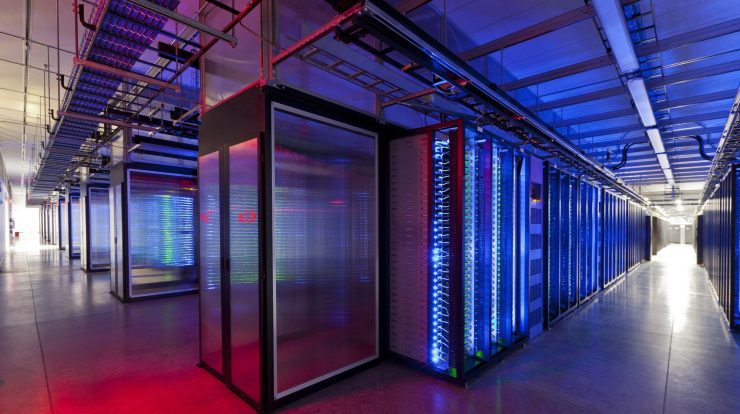
Modern life runs on data centers. Every search, video stream, AI prompt, financial transaction, and cloud application depends on massive, highly engineered facilities that house tens of thousands of servers. While most people never see them, the world’s most popular data centers are among the most strategically important infrastructures ever built.
What Makes a Data Center “Popular”?
When we talk about “popular” data centers, we’re usually referring to:
- Hyperscale operators (companies running global cloud platforms)
- Colocation giants (facilities that host thousands of customer systems)
- AI and cloud infrastructure leaders
- Facilities with global scale, redundancy, and certifications
The modern internet is dominated by a small group of hyperscalers, including Amazon Web Services (AWS), Microsoft Azure, and Google Cloud. Together, they operate a significant portion of the world’s compute capacity.
In fact, there are now around 1,300 hyperscale data centers globally, with AWS, Microsoft, and Google controlling more than half of all hyperscale capacity worldwide. (CRN)
The Hyperscale Giants: Who Runs the World’s Data Centers?
1. Amazon Web Services (AWS)
AWS is widely considered the largest cloud infrastructure provider in the world.
- Operates 32 cloud regions
- Has 102 availability zones
- Total footprint: approximately 33.5 million square feet
- Strong global presence across compute, storage, and networking services (Dgtl Infra)
AWS data centers form the backbone of much of the internet—from Netflix streaming to enterprise databases and AI workloads.
AWS also uses a multi-layer architecture (perimeter, infrastructure, data, and environmental layers) to ensure resilience and security across its global network.
2. Microsoft Azure
Microsoft Azure is the second-largest hyperscale operator globally.
- Operates 62 cloud regions
- Has 120 availability zones
- Linked by more than 175,000 miles of fiber optic infrastructure
- Runs 200+ data center facilities globally (Dgtl Infra)
Azure is especially dominant in enterprise environments due to its integration with Microsoft software ecosystems such as Windows Server, SQL Server, and Office 365.
3. Google Cloud Platform (GCP)
Google Cloud is built on the same infrastructure that powers Google Search, YouTube, and AI systems.
- Operates 39 cloud regions
- Has 118 availability zones (IBM)
- Known for AI, machine learning, and advanced analytics capabilities
Google’s data centers are also famous for energy efficiency innovations, including custom cooling systems and machine learning-based power optimization.
4. Meta (Facebook Infrastructure)
Meta operates one of the largest private data center networks in the world.
- Supports Facebook, Instagram, WhatsApp, and VR systems
- Heavy investment in AI infrastructure and global connectivity
- Expanding rapidly into multi-gigawatt AI data center campuses (Reddit)
Meta’s infrastructure is optimized for social media scale—handling billions of daily users with extremely low latency requirements.
5. Oracle Cloud Infrastructure (OCI)
Oracle is a major enterprise cloud provider focused on databases and business systems.
- Rapidly expanding global data center footprint
- Strong presence in government and financial sectors
- Known for high-performance database infrastructure
6. Alibaba Cloud
Alibaba Cloud is one of the largest hyperscale providers outside the United States.
- Operates major data centers across Asia, Europe, and the Middle East
- Strong dominance in e-commerce infrastructure
- Expanding rapidly in global cloud services
Global Scale of Data Center Infrastructure
The scale of modern data centers is difficult to comprehend without numbers:
- Hundreds of millions of servers globally
- Thousands of hyperscale and colocation facilities
- Millions of square feet of infrastructure per major provider
- Massive yearly capital investment into expansion
The United States alone hosts more than 5,000+ data centers, making it the largest data center market in the world. (Reddit)
Meanwhile, hyperscale expansion continues accelerating due to:
- Artificial intelligence workloads
- Cloud migration
- Streaming and content delivery demand
- Edge computing growth
The Largest Data Center Facilities in the World
Beyond cloud providers, there are massive standalone campuses designed specifically for scale.
Switch Citadel (Nevada, USA)
One of the largest data center campuses in the world:
- ~7.2 million square feet
- ~650 MW power capacity
- Built for extreme redundancy and security
- Uses renewable energy infrastructure
- Designed for hyperscale computing and enterprise hosting (Reddit)
QTS Atlanta-Metro Campus
- Nearly 1 million square feet
- Over 270 MW capacity
- Designed for hyperscale tenants and government workloads (Reddit)
SUPERNAP (Las Vegas, Nevada)
- 1.4 million square feet
- High-density server environments
- Advanced cooling systems supporting up to 1,500 watts per square foot (Reddit)
These facilities represent the physical backbone of the cloud.
Why Certifications Matter in Data Centers
Data centers are not just built—they are certified.
Because downtime can cost millions of dollars per minute, global certification systems exist to ensure reliability, redundancy, and fault tolerance.
The most important certification body is the Uptime Institute.
Uptime Institute Tier Certification System
The Uptime Institute defines the global standard for data center reliability through its Tier Classification System.
There are four tiers:
Tier I – Basic Infrastructure
- Basic capacity for IT systems
- No redundancy
- Requires shutdown for maintenance (Uptime Institute)
Tier II – Redundant Components
- Some redundant cooling and power components
- Partial protection against disruptions (Uptime Institute)
Tier III – Concurrently Maintainable
- Systems can be maintained without downtime
- Highly popular among enterprises
- Designed for ~99.982% uptime (Reddit)
Tier IV – Fault Tolerant
- Fully redundant systems (2N+1 design)
- Can handle unexpected failures without downtime
- Designed for ~99.995% uptime (Reddit)
Tier IV facilities are often used for:
- Financial trading systems
- Government infrastructure
- Critical AI and cloud workloads
What the Uptime Certification Really Ensures
The certification process evaluates:
- Electrical systems (power redundancy)
- Cooling infrastructure
- Physical security
- Fire protection systems
- Operational procedures
- Maintenance capability
- Environmental controls (Uptime Institute)
A key point: certification is not just about design—it also evaluates how the facility is operated in real-world conditions.
Uptime Institute has issued thousands of certifications across more than 100 countries, making it the global benchmark for data center reliability. (airs.uptimeinstitute.com)
Other Important Data Center Standards
While Uptime Tier Certification is the most recognized, data centers also commonly follow:
- ISO 27001 (information security management)
- SOC 1 / SOC 2 audits (service organization controls)
- PCI DSS (payment security compliance)
- LEED certifications (energy efficiency and sustainability)
These frameworks ensure that data centers are not only reliable but also secure and environmentally responsible.
The Future of Data Centers: AI-Driven Growth
The biggest change happening in data centers today is artificial intelligence.
AI workloads require:
- Massive GPU clusters
- High-density power systems
- Advanced cooling (liquid and immersion cooling)
- Ultra-low latency networking
This is driving explosive growth in hyperscale infrastructure investment. Since the rise of generative AI, both capacity and capital spending on data centers have significantly increased worldwide. (CRN)
Conclusion: The Invisible Infrastructure of the Internet
The world’s most popular data centers are not just buildings—they are the foundation of the digital economy.
From AWS and Azure operating hundreds of global regions, to massive campuses like Switch Citadel, to strict Tier IV certified facilities ensuring near-perfect uptime, these systems work together to keep the internet running 24/7.
What makes them truly remarkable is not just their size, but their engineering discipline:
- Redundant power everywhere
- Fault-tolerant architectures
- Global distribution
- Strict certification systems
- Constant expansion driven by AI and cloud demand
In short, the modern world doesn’t just use data centers—it depends on them entirely.
Here’s a breakdown of the Top 10 largest individual data centers in the world, focusing on scale (MW capacity + size), operators, and why they matter. These are mostly hyperscale or mega-colocation campuses—not single server rooms, but massive infrastructure cities built for the cloud.
🌍 Top 10 Largest Individual Data Centers in the World
🥇 1. Switch – The Citadel Campus (Nevada, USA)
- Power capacity: ~650 MW (one of the highest in the world)
- Area: ~7.2 million sq ft (668,901 m²)
- Operator: Switch
- Type: Hyperscale colocation campus
The Citadel is often considered the largest operational data center campus globally. It is built for extreme density computing, cloud providers, and enterprise workloads. It uses advanced cooling systems and is designed for full redundancy and resilience.
Why it matters:
- Fully renewable energy powered
- Tier IV-level infrastructure design principles
- Built for AI-scale workloads and cloud hyperscalers
📊 It represents the modern “data center city” concept.
🥈 2. China Telecom – Inner Mongolia Information Park (China)
- Power capacity: ~150 MW+
- Area: ~10.7 million sq ft (one of the largest by land footprint)
- Operator: China Telecom
This is one of the largest physical footprint data center campuses in the world. It benefits from the cold climate of Inner Mongolia, reducing cooling costs dramatically.
Why it matters:
- Massive national telecom backbone facility
- Optimized for energy efficiency through natural cooling
- Core part of China’s cloud infrastructure expansion
🥉 3. Switch – SUPERNAP Campus (Las Vegas, USA)
- Power capacity: ~280 MW
- Area: ~1.4 million sq ft
- Operator: Switch
SUPERNAP is famous for high-density racks and extreme engineering design.
Key features:
- Supports up to 1,500 watts per sq ft power density
- Houses 100+ cloud and hosting providers
- Advanced airflow containment and modular cooling
4. QTS Atlanta Metro Data Center (Georgia, USA)
- Power capacity: ~278 MW+
- Area: ~990,000 sq ft
- Operator: QTS Realty Trust
One of the most important enterprise and hyperscale hybrid campuses in the U.S.
Why it matters:
- Strong carrier connectivity
- Massive redundancy via on-site substations
- Used by government and enterprise clients
5. Harbin Data Center (China)
- Power capacity: ~200 MW
- Area: ~7+ million sq ft (varies by build phase)
- Operator: China Mobile
Located in a cold region that reduces cooling costs significantly.
Key strengths:
- Efficient natural cooling climate
- Supports telecom, cloud, and government systems
- Part of China’s distributed national cloud strategy
6. Alibaba Zhangbei Data Center (China)
- Power capacity: ~150 MW
- Area: ~7+ million sq ft
- Operator: Alibaba Cloud
A cornerstone of Alibaba’s global cloud infrastructure.
Why it matters:
- Supports e-commerce, AI, and logistics systems
- Uses cool climate optimization
- One of Asia’s largest cloud hubs
7. Range International Information Hub (Langfang, China)
- Power capacity: ~150 MW
- Area: ~6.6 million sq ft
- Operator: Range Technology
This is a multi-building mega-campus designed for scalable expansion.
Key strengths:
- Built as a modular “data city”
- High redundancy architecture
- Supports enterprise and cloud hosting ecosystems
8. Lakeside Technology Center (Chicago, USA)
- Power capacity: ~100 MW
- Area: ~1.1 million sq ft
- Operator: Digital Realty (historically)
One of the most important interconnection hubs in North America.
Why it matters:
- Massive fiber connectivity hub
- Long-standing telecom and internet backbone facility
- Critical peering location for U.S. internet traffic
9. Utah Data Center (Bluffdale, USA)
- Power capacity: ~65 MW
- Area: ~1.3 million sq ft
- Operator: U.S. government (NSA)
This is one of the most secure and secretive data centers in the world.
Key purpose:
- National security and intelligence storage
- Massive-scale data analytics infrastructure
- Built for extremely long-term data retention
10. Apple Mesa Data Center (Arizona, USA)
- Power capacity: ~50 MW
- Area: ~1.3 million sq ft
- Operator: Apple
Apple’s infrastructure is highly optimized for iCloud, services, and global content delivery.
Why it matters:
- Focused on Apple ecosystem services
- Strong renewable energy integration
- Highly efficient server design and cooling systems
⚡ Key Insights Across All Top Data Centers
1. Power is the real metric (not just size)
Modern data centers are measured more by megawatts (MW) than square footage.
- Small enterprise: 1–5 MW
- Large facility: 20–100 MW
- Hyperscale campus: 150–650+ MW
A single large AI campus can consume the equivalent electricity of a small city.
2. Climate matters more than people think
Many of the largest facilities are located in:
- Cold climates (China north, Utah, Ireland, Norway)
- Dry climates (Nevada, Arizona)
Why?
- Lower cooling costs
- Higher energy efficiency
- Reduced infrastructure strain
3. Redundancy is everything
Top-tier data centers are engineered with:
- Multiple independent power feeds
- Backup diesel or gas generators
- Dual fiber routes
- Independent cooling systems
Even a few minutes of downtime can cost millions.
4. Hyperscalers dominate the list
Most of the largest facilities belong to:
- AWS
- Microsoft (Azure ecosystem not listed here but massive globally)
- Alibaba
- Meta
- Apple
- Major colocation providers (Switch, QTS, Digital Realty)
This shows how centralized the internet has become.
5. Certifications define reliability
To operate at this level, data centers commonly meet:
🔒 Uptime Institute Tier Standards
- Tier III: concurrent maintenance
- Tier IV: fault-tolerant (highest standard)
🔐 ISO 27001
- Information security management
💳 SOC 2 / SOC 1
- Operational and financial controls
⚡ Energy certifications
- LEED (green building)
- Energy Star / PUE efficiency standards
🧠 Final Thoughts
The world’s largest data centers are no longer just buildings—they are industrial-scale computing ecosystems.
A single facility like Switch Citadel or Alibaba Zhangbei can:
- Power global cloud services
- Run AI training clusters
- Support billions of daily requests
- Store exabytes of data
And behind all of it is a strict framework of engineering standards and certifications ensuring they never go offline.
If the internet is the nervous system of the modern world, these data centers are the organs keeping it alive.
If you want, I can next:
- Compare hyperscale vs colocation data centers
- Break down how Tier III vs Tier IV actually works in real design
- Or explain what it costs to build a 100 MW data center today

With 23+ years in the Web Hosting Industry, Brian has had the opportunity to design websites for some of the largest companies in the industry. Brian currently holds the position as Co-Founder and Creative Director at WebHosting,coop Internet Cooperative