
In today’s competitive marketplace, businesses live and die by customer perception. It’s no longer enough to simply provide a good product or service—customers expect exceptional experiences, and they’re quick to share their opinions. That’s where the Net Promoter Score (NPS) comes in. It has become one of the most widely used metrics for measuring customer loyalty and satisfaction, helping organizations understand not just how customers feel, but how likely they are to advocate for the brand.
This post breaks down what NPS is, how it works, its advantages, and what qualifies as good or bad performance.
What Is Net Promoter Score (NPS)?
Net Promoter Score (NPS) is a customer loyalty metric developed to measure how likely customers are to recommend a company, product, or service to others. At its core, it simplifies customer sentiment into a single, easy-to-understand number.
The NPS system is based on one key question:
“How likely are you to recommend our company/product/service to a friend or colleague?”
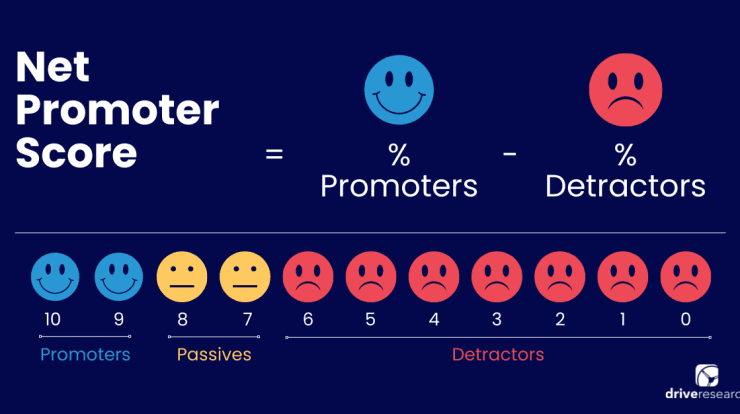
Customers respond on a scale from 0 to 10. Based on their answers, they are grouped into three categories:
Promoters (9–10):
These are your most loyal and enthusiastic customers. They are likely to recommend your business and help drive organic growth through word-of-mouth.
Passives (7–8):
These customers are satisfied but not particularly enthusiastic. They are vulnerable to competitors and unlikely to actively promote your brand.
Detractors (0–6):
These customers are unhappy or dissatisfied. They may discourage others from using your business and can harm your reputation.
How NPS Is Calculated
The Net Promoter Score is calculated by subtracting the percentage of detractors from the percentage of promoters:
NPS = % of Promoters − % of Detractors
Passives are not included in the calculation—they act as a neutral middle group.
Example:
- 60% Promoters
- 25% Passives
- 15% Detractors
NPS = 60 − 15 = 45
The final score ranges from -100 to +100.
Why NPS Matters
NPS has gained popularity because it provides a quick snapshot of customer sentiment and loyalty. Unlike complex surveys, it cuts through noise and focuses on what really matters: whether your customers are willing to advocate for you.
Customer advocacy is powerful. A recommendation from a friend or colleague often carries more weight than advertising. Businesses with high NPS scores tend to grow faster because they benefit from this organic trust.
Advantages of Using NPS
Simplicity and Ease of Use
One of the biggest strengths of NPS is its simplicity. It relies on a single question, making it easy for customers to respond and for companies to analyze results. This simplicity also encourages higher response rates compared to longer surveys.
Standardized Benchmarking
Because NPS is widely used across industries, it allows businesses to benchmark their performance against competitors. You can compare your score to industry averages and track your progress over time.
Focus on Customer Loyalty
Many metrics measure satisfaction, but NPS goes a step further by measuring loyalty. A satisfied customer may still switch to a competitor, but a promoter is far more likely to stay loyal and advocate for your brand.
Actionable Insights
NPS surveys are often paired with follow-up questions like “Why did you give this score?” This qualitative feedback helps identify specific areas for improvement—whether it’s customer service, pricing, or product quality.
Predictive Growth Indicator
A strong NPS often correlates with business growth. Companies with higher scores tend to have better retention rates, more referrals, and stronger brand equity.
Organization-Wide Alignment
Because NPS is easy to understand, it can be adopted across departments—from marketing to customer support to product development. Everyone can rally around improving the score.
Interpreting NPS Scores: What’s Good and What’s Bad?
Understanding what your NPS means is just as important as calculating it. The score itself only becomes valuable when you know how to interpret it.
The NPS Scale
- -100 to 0: Poor
- 0 to 30: Fair
- 30 to 50: Good
- 50 to 70: Excellent
- 70 to 100: World-class
What Is Considered a Good NPS?
A score above 0 is generally considered acceptable, as it means you have more promoters than detractors. However, most successful businesses aim higher.
- Above 30: Indicates a healthy level of customer satisfaction and loyalty
- Above 50: Strong performance, with a loyal customer base
- Above 70: Exceptional—these companies often dominate their markets
What Is Considered a Bad NPS?
A negative score is a red flag. It means you have more unhappy customers than happy ones.
- Below 0: Serious issues with customer experience
- Below -20: Indicates widespread dissatisfaction
- Near -100: Extremely poor performance (rare, but critical)
Low scores often signal problems such as poor customer service, unreliable products, or unmet expectations.
Industry Differences Matter
It’s important to understand that NPS benchmarks vary by industry. For example:
- Tech companies often have higher NPS scores due to innovation and strong customer engagement
- Telecom and utility companies tend to have lower scores due to limited competition and service frustrations
- Hospitality and retail industries often fall somewhere in between
Comparing your score to direct competitors or industry averages gives a more accurate picture than relying on general benchmarks.
How to Improve Your NPS
Improving your NPS isn’t about chasing a number—it’s about improving the customer experience.
Listen to Customer Feedback
Always include an open-ended follow-up question. The insights you gain from customer comments are often more valuable than the score itself.
Close the Loop
Follow up with detractors to understand their concerns and resolve issues. This can turn unhappy customers into loyal ones.
Empower Your Team
Customer-facing employees play a huge role in shaping experiences. Training and empowering them to solve problems quickly can have a direct impact on your NPS.
Identify Patterns
Look for trends in feedback. Are customers complaining about the same issue repeatedly? Fixing systemic problems can significantly boost your score.
Focus on the Customer Journey
Evaluate every touchpoint—from onboarding to support—to ensure a consistent and positive experience.
Common Mistakes to Avoid
Over-Focusing on the Score
NPS is a tool, not a goal. Chasing a higher score without addressing underlying issues can lead to short-term gains but long-term problems.
Ignoring Passives
While passives don’t affect the score directly, they represent an opportunity. Converting them into promoters can significantly improve your overall performance.
Survey Fatigue
Sending too many surveys can annoy customers and reduce response rates. Be strategic about when and how often you ask for feedback.
Final Thoughts
The Net Promoter Score is more than just a number—it’s a reflection of how your customers truly feel about your business. Its simplicity, scalability, and focus on loyalty make it one of the most powerful tools for measuring customer experience.
A strong NPS indicates that your customers trust you, value your offerings, and are willing to advocate for your brand. A weak score, on the other hand, is a clear signal that something needs to change.
Ultimately, the goal isn’t just to improve your NPS—it’s to create experiences so good that customers naturally want to recommend you. When that happens, growth follows.

With 23+ years in the Web Hosting Industry, Brian has had the opportunity to design websites for some of the largest companies in the industry. Brian currently holds the position as Co-Founder and Creative Director at WebHosting,coop Internet Cooperative