
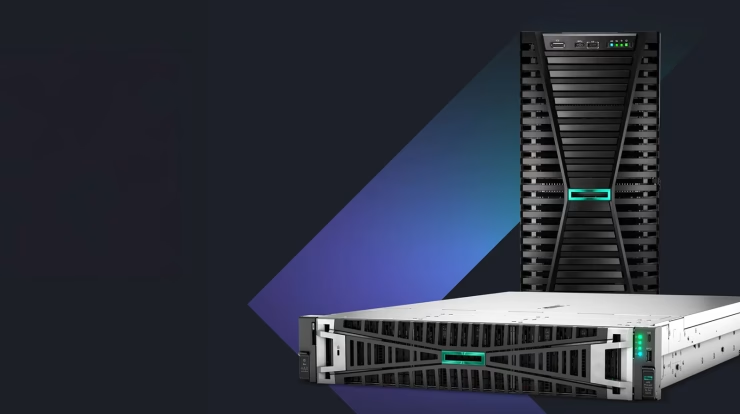
When people ask for the “best” server hardware brand, they’re usually hoping for a simple winner. The reality is more nuanced: enterprise server hardware is dominated by a handful of elite manufacturers, and the “best” depends on reliability, scalability, support ecosystem, performance, and total cost of ownership. That said, one brand consistently rises to the top across most enterprise use cases: Hewlett Packard Enterprise (HPE)—particularly its **HPE ProLiant line of servers.
A Legacy of Enterprise Reliability
HPE’s dominance in server hardware didn’t happen overnight. The ProLiant line dates back to the 1990s and has been refined through decades of enterprise deployment. ProLiant systems have historically led the x86 server market in both shipments and revenue, reflecting widespread trust in their reliability. (Wikipedia)
Reliability is not just about uptime—it’s about predictable performance under stress. HPE servers are engineered with:
- Redundant power supplies
- Hot-swappable components
- Advanced thermal management
- Enterprise-grade testing standards
These features ensure that even mission-critical systems (banks, hospitals, cloud providers) can operate continuously without catastrophic failure.
Performance and Scalability
Modern workloads—AI, virtualization, big data—require massive compute power. HPE excels here by offering highly scalable systems.
For example, the ProLiant DL380 platform supports:
- Dual Intel Xeon processors
- Dozens of CPU cores
- Up to terabytes of RAM
- Flexible storage configurations (SATA, SAS, NVMe) (Techbuyer)
This scalability allows businesses to start small and grow without replacing their infrastructure.
Best Overall Example
Best overall: HPE ProLiant DL380 Gen11
The DL380 is widely considered the gold standard of enterprise servers. It balances:
- Performance (dual-socket CPUs, high core counts)
- Expandability (massive RAM and storage support)
- Reliability (redundancy and fault tolerance)
- Security (firmware-level protections)
It’s used everywhere from corporate data centers to cloud infrastructure providers.
Security: A Major Differentiator
One of HPE’s strongest advantages is its security architecture. Features like Silicon Root of Trust protect firmware from tampering, which is critical in an era of hardware-level cyber threats.
In contrast, many competitors offer strong security—but HPE integrates it deeper into the hardware lifecycle, including:
- Secure boot processes
- Firmware validation
- Automatic recovery from attacks
This is particularly valuable for government, finance, and healthcare sectors.
Management Tools and Automation
HPE’s iLO (Integrated Lights-Out) management system allows administrators to:
- Monitor servers remotely
- Deploy updates
- Troubleshoot without physical access
This reduces operational overhead and enables automation at scale.
Innovation and Future-Readiness
HPE invests heavily in next-generation computing, including:
- AI infrastructure
- Hybrid cloud solutions
- Edge computing systems
Recent ProLiant systems can support:
- Hundreds of CPU cores
- GPU acceleration
- Liquid cooling
- Extreme environmental resilience (for edge deployments) (IT Pro)
This forward-thinking approach ensures that businesses aren’t just buying hardware—they’re investing in a platform that will remain relevant for years.
Other Top Server Brands (And How They Compare)
While HPE often ranks first, it’s not the only serious contender.
Dell PowerEdge: The Strong Challenger
Dell PowerEdge servers are arguably HPE’s biggest competitor.
Strengths:
- Excellent ease of use
- Strong remote management (iDRAC)
- Consistent hardware design across models (Wikipedia)
- Competitive pricing
Dell is often preferred by organizations that prioritize simplicity and accessibility.
Weaknesses:
- Slightly less advanced security architecture
- Sometimes less flexible customization than HPE
Lenovo ThinkSystem: The Value Performer
Lenovo ThinkSystem servers are another major player.
Strengths:
- Competitive pricing
- Solid performance
- Good reliability
Weaknesses:
- Smaller ecosystem
- Less dominant enterprise presence
- Fewer advanced management features
Lenovo is often chosen by businesses looking for cost-effective enterprise hardware.
Real-World Perspective: What IT Professionals Say
In practice, many IT professionals see the choice as a trade-off rather than a clear winner. Some prefer Dell for usability, while others stick with HPE for its consistency and enterprise pedigree.
Here are a few representative perspectives:
The takeaway is clear:
- HPE excels in enterprise environments with full support contracts
- Dell often wins in flexibility and ease of use
PRODUCT COMPARISON TABLE
| Attribute | HPE ProLiant DL380 Gen11 Rack Server | HPE ProLiant DL380 Gen10 Rack Server | HPE ProLiant DL380 Gen10 8-Bay Server | HPE ProLiant DL380 Gen10 12-Bay Server |
|---|---|---|---|---|
| Target Use | Enterprise / Data Center | Enterprise | SMB / Enterprise | Data-intensive workloads |
| CPU Support | Latest Xeon (Gen11) | Xeon Scalable | Dual Xeon Gold | Dual Xeon Gold |
| Max Performance | Very High | High | High | Very High |
| Storage Flexibility | Extensive (NVMe/SAS) | High | Moderate | Very High |
| Scalability | Excellent | Excellent | Good | Excellent |
| Price Range | Premium | Mid–High | Budget–Mid | Mid–High |
What Actually Makes a Server Brand “The Best”
Instead of focusing only on brand names, it’s more useful to understand the criteria:
Reliability
Downtime is expensive. Enterprise-grade redundancy is essential.
Scalability
Your hardware should grow with your business.
Support Ecosystem
Enterprise vendors differentiate themselves heavily here.
Security
Firmware-level protection is now a necessity.
Total Cost of Ownership
Initial price is only part of the equation—maintenance and upgrades matter more long-term.
Final Verdict
If you had to crown one brand as the best overall, HPE stands out because it delivers the most complete package:
- Industry-leading reliability
- Exceptional scalability
- Advanced security features
- Strong enterprise ecosystem
However, it’s not a one-size-fits-all answer:
- Choose HPE for mission-critical enterprise environments
- Choose Dell PowerEdge for ease of use and flexibility
- Choose Lenovo ThinkSystem for value-focused deployments
The truth is, the “best” server hardware isn’t just about the brand—it’s about how well that hardware aligns with your specific workload, budget, and long-term goals.
Explore More

With 23+ years in the Web Hosting Industry, Brian has had the opportunity to design websites for some of the largest companies in the industry. Brian currently holds the position as Co-Founder and Creative Director at WebHosting,coop Internet Cooperative